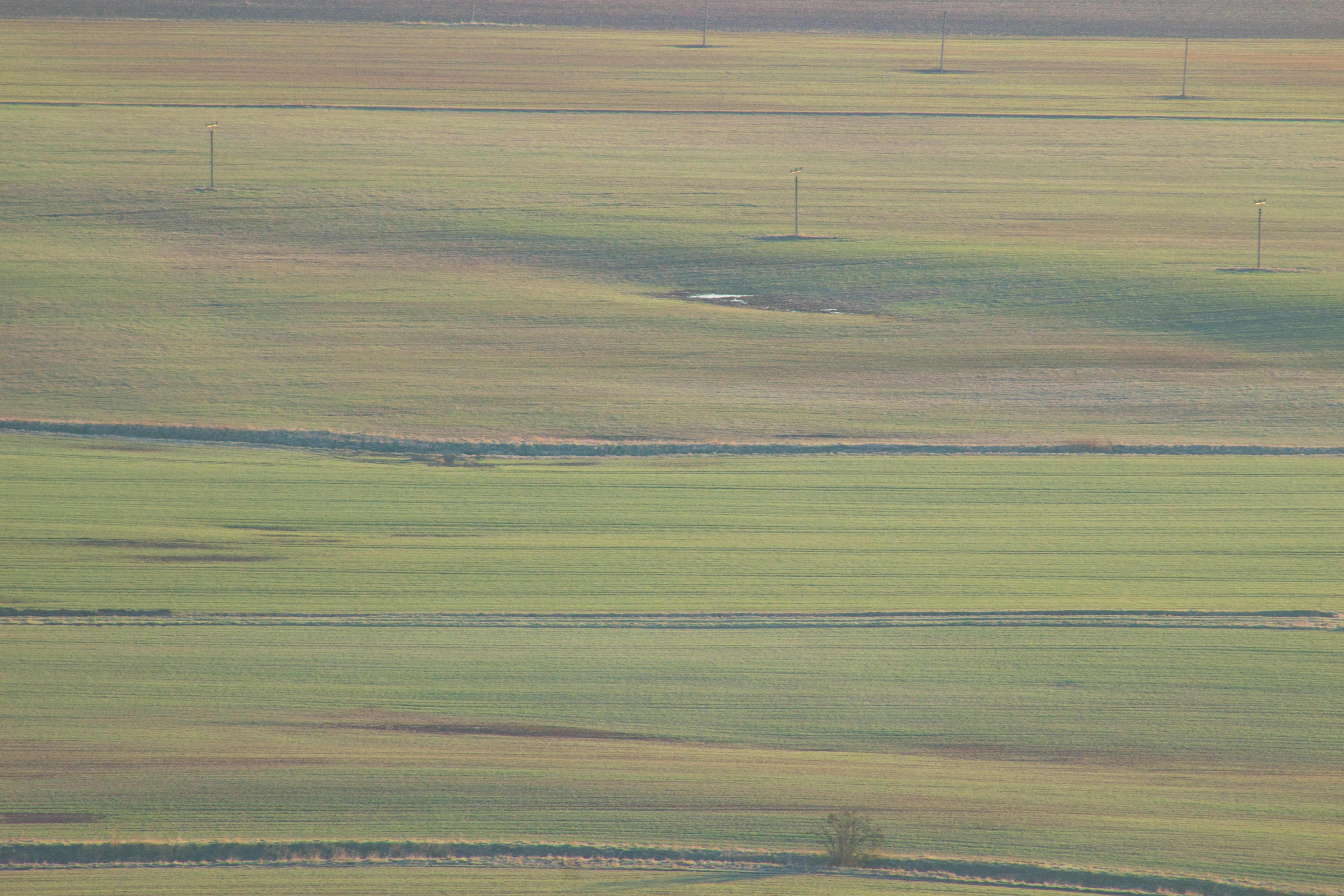

When I look, I think of poetry. Verses from poems read long ago or just recently come to mind, whether I am merely gazing at the landscape or standing right within it. Across the azure blue — I would like to meet you in the meadows — light as a handkerchief, simple as a postcard — sweet as the soft crumb of a roll — if you leave me, you shall perish! — why do you come to wither in my orchard? — the son’s blood flows over it — there is much sorrow, one can gather it — yet there was something beautiful here that crushes, courage and joy in both life and death — but you are dearer to me than any homeland… The sweetest and bitterest words transformed into a blend of pathos. In the effort to break free from the jumble of random verses, only one remains; repeated to the point of exhaustion like a mantra that stifles thought. And suddenly, there is silence. There are only boots growing heavy with the clinging clay soil, the wind in the crowns of trees not yet in leaf, and colors.
When I look, I think of paintings. Genre landscapes — images that gave rise to the word "picturesque," an adjective describing a scene worthy of being captured with colors and brushes. Paintings are the first thing I see upon waking; they are my livelihood and a frequent topic of conversation at home. He paints based on my photographs. I take photographs that resemble his paintings. What fascinates me about his brisk, almost expressive brushstrokes is that liberating reduction—one capable of capturing the very essence: the impression. How much more charm and poetry lies in the word "picturesque" compared to "photogenic" (possessing the "gene" for capture by a camera) — a term that is coldly scientific and laughably rational. I lack the talent, the ability, the patience, and above all the courage to pick up a paintbrush; for me, the camera serves as brush, palette, and canvas—just as it was once the "pencil of nature" for William Fox Talbot.
When I look, I think of home. Dreams of distant lands have gradually been eclipsed by a love for my native country. Just as I once spent hours watching the ocean or the desert in endless fascination, I am now stirred to the same—if not greater—rapture by the shadows of drifting clouds across a field, the sun’s rays reflecting off pine bark in the woods beyond my hometown, and the scent of rain-washed cobblestones on our street at the onset of summer.
In the end, my heart remained where I had felt happiest during those six months — in a place where the carousel of everyday life and bizarre events grinds to a halt, where all eras merge into the present, and only silence exists. The Broumov landscape is a kind of terra oblita — a region long overlooked, and for many, practically terra prohibita: the end of the world, a place no one visits and from which no one returns alive. If it were up to me, I wouldn’t have returned either. I would have built myself a house out of sorrow amidst that sea of red earth and wouldn’t have opened the door to turbots for a thousand years.
✲
Když se dívám, myslím na poezii. Vybavují se mi verše dávno i nedávno čtených básní, ať se jen dívám do krajiny nebo v ní přímo jsem. Po modrém blankytu – chtěl bych tě potkati v lukách – lehká jak kapesník, prostá jak pohlednice – sladká jak střída dalamánku – opustíš-li mne, zahyneš! – proč jdete vadnout na můj sad? – krev syna teče po ní – je mnoho smutku lze ho sbírat – bylo tu však něco krásného co drtí, odvaha a radost z života i smrti – ale tys nad všechny vlasti mi milejší… Ta nejsladší i nejhořčí slova přeměněná ve směs patosu. Díky snaze vymanit se ze skrumáže náhodných veršů zbude jen jeden; do úmoru opakovaný jako mantra znemožňující myšlení. A najednou je ticho. Jsou jen boty těžknoucí od neustále se nabalující jílovité půdy, vítr v korunách ještě neolistěných stromů, barvy.
Když se dívám, myslím na obrazy. Žánrové krajinky, obrazy, které daly stvořit slovo „malebný“, adjektivum označující situaci hodnou zaznamenání pomocí barev a štětců. Obrazy jsou první věc, kterou vidím hned po probuzení, jsou mojí pracovní náplní, jsou pravidelným tématem domácích rozhovorů. Maluje podle mých fotek. Dělám fotografie jako jeho obrazy. Co mě fascinuje v jeho svižných až expresivních tazích je ta osvobozující redukce, která je ale schopna zachytit to nejpodstatnější – impresi. O kolik více půvabu a poezie je v tomhle slově „malebný“, oproti slovu „fotogenický“ (mající „gen“ pro zaznamenání pomocí fotoaparátu),
které je studeně vědecké a směšně racionální. Nemám talent, schopnost, trpělivost a především odvahu vzít do ruky štětec – mým štětcem, mou paletou i plátnem je fotoaparát, tak jako byl kdysi pro Williama Foxe Talbota tužkou přírody.
které je studeně vědecké a směšně racionální. Nemám talent, schopnost, trpělivost a především odvahu vzít do ruky štětec – mým štětcem, mou paletou i plátnem je fotoaparát, tak jako byl kdysi pro Williama Foxe Talbota tužkou přírody.
Když se dívám, myslím na domov. Sny o dalekých krajích postupně přehlušila láska k rodné zemi. Tak jako jsem dřív vydržela hodiny pozorovat oceán či poušť v nekonečné fascinaci, stejné, ne-li větší, vytržení ve mně vyvolávají stíny táhnoucích mraků na poli, sluneční paprsky odrážející se od kůry borovic v lese za rodným městem, vůně deštěm smáčených dlažebních kostek v naší ulici se začínajícím létem.
Nakonec jsem zůstala v srdci tam, kde mi bylo ten půlrok nejlíp, v místě, kde se kolotoč všedních dní a bizarních událostí zastaví, všechny časy se spojí v přítomnost a existuje jen ticho. Broumovská krajina je jakási terra oblita, kraj, který byl dlouhou dobu na okraji zájmu a pro mnoho lidí byl až terrou prohibitou, koncem světa, kam se nechodí a odkud se nikdo živý nevrací. Kdyby to bylo na mně, taky bych se nevrátila. Vystavěla bych si dům ze smutku v tomhle moři červenozemě a kambalám bych neotevírala klidně tisíc let.